
Differences Between Surge Arrester And Surge Protection Device
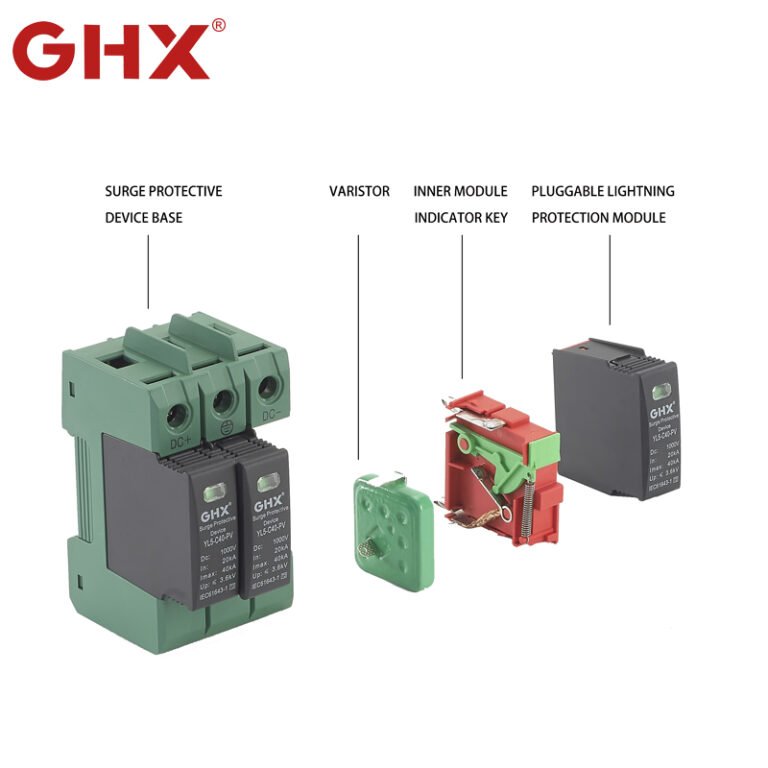
Surge protection devices (SPD) and surge arresters have the same function: they can protect electrical equipment from overvoltage conditions, but what is the difference between them? The following is a brief description of the differences between them.
1. Different Rated Voltages:
According to NEC 2017 Sec 280 & 285, the rated voltage of the surge arrester is over 1KV. They can prevent very large fault currents, such as those caused by lightning. The rated voltage of SPD does not exceed 1KV, for example. 380V, 220V. Surge arresters 1000 volts or less are also known as Type 1 SPDs.
2. Different Applications:
Surge arresters protect medium to high voltage equipment. Utility companies use surge arresters in power transmission and distribution systems to protect their electronic equipment and infrastructure. Surge arresters can also be found in large industrial companies, such as mining, oil, or natural gas. SPD protects low-voltage equipment for household and civil use, such as washing machines, refrigerators, or entire houses.
3. Different installation positions:
The surge arrester is usually installed on the first system to prevent the direct intrusion of lightning and protect overhead lines and electrical equipment; the SPD is usually installed on the auxiliary system, which is a supplement after the surge arresters eliminate the direct intrusion of lightning or the surge arresters cannot directly eliminate all the intrusions Measures. Therefore, the surge arresters are usually installed at the wire entrance, and the SPD is installed at the terminal socket or signal circuit.
4. Different Discharge Current Capacity:
Since the main function of surge arresters is to prevent lightning overvoltage, the discharge current capacity is relatively high. The discharge current capacity of SPD is usually not high. The terminal usually uses SPD. It will not be directly connected to overhead lines. After passing the primary current limiting function, the lightning current has been limited to a very low value, so that the SPD with low discharge current capacity can fully protect it. SPD is suitable for the precise protection of low-voltage power supply systems.
5. Different materials:
The main material of surge arresters is Zinc oxide. The main material of SPD varies according to the grade and classification protection of the torch resistance (IEC61312). Besides, the design of the SPD is more precise than that of the surge arresters. Further, from a technical point of view, the response time, the effect of the pressure limiting aspect, a comprehensive protective effect, anti-aging performance point of view, the surge arresters do not reach the level of SPD.
6. Different sizes:
As the surge arresters are linked to the main electrical system, they must have sufficient external insulation performance and a large appearance size. Since the SPD is connected to the low-voltage system, the size of the SPD can be small.
We provides single-phase SPD, three-phase SPD, and DC SPD for solar PV systems with high quality and the best service.For more on this, or to learn about any of our other electrical services, contact us today.