Propagation of a lightning wave
Electrical networks are low-frequency and, as a result, propagation of the voltage wave is instantaneous relative to the frequency of the phenomenon: at any point of a conductor, the instantaneous voltage is the same.
The lightning wave is a high-frequency phenomenon (several hundred kHz to a MHz):
1. The lightning wave is propagated along a conductor at a certain speed relative to the frequency of the phenomenon. As a result, at any given time, the voltage does not have the same value at all points on the medium (see Fig. 1).
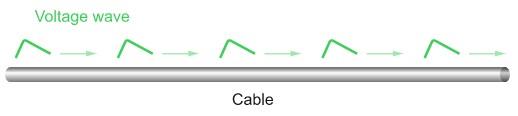
Fig. 1 – Propagation of a lightning wave in a conductor
1. A change of medium creates a phenomenon of propagation and/or reflection of the wave depending on:
2.1 the difference of impedance between the two media;
2.2 the frequency of the progressive wave (steepness of the rise time in the case of a pulse);
2.3 the length of the medium.
In the case of total reflection in particular, the voltage value may double.
Example: case of protection by a SPD
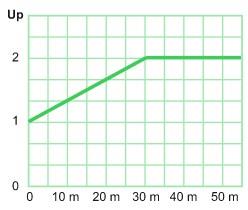
Modelling of the phenomenon applied to a lightning wave and tests in laboratory showed that a load powered by 30 m of cable protected upstream by a SPD at voltage Up sustains, due to reflection phenomena, a maximum voltage of 2 x Up (see Fig. 2). This voltage wave is not energetic.
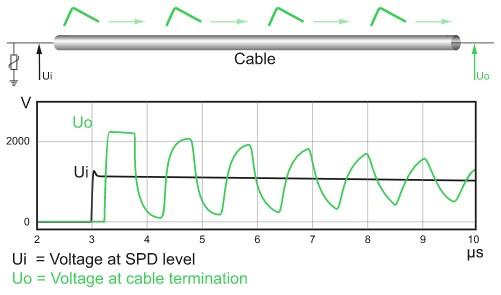
Fig. 2 – Reflection of a lightning wave at the termination of a cable
Corrective action
Of the three factors (difference of impedance, frequency, distance), the only one that can really be controlled is the length of cable between the SPD and the load to be protected. The greater this length, the greater the reflection.
Generally for the overvoltage fronts faced in a building, reflection phenomena are significant from 10 m and can double the voltage from 30 m (see Fig. 3).
It is necessary to install a second SPD in fine protection if the cable length exceeds 10 m between the incoming-end SPD and the equipment to be protected.